
Continuous audit intelligence for maritime

Anticipate audit risk
before it becomes a detention.

Maritime audit is a leading indicator. Treat it like one.

Safyrmind turns maritime findings into actionable intelligence. Every finding is interpreted against the vessel, equipment, applicable regulations, historical findings and previously validated CAPAs. Our ontology-guided retrieval and domain-adapted AI then generate a finding-specific corrective and preventive action, with supporting evidence and regulatory provenance. Every validated CAPA makes the system smarter — turning isolated findings into fleet-wide intelligence.

9
Regulatory
regimes covered
5
Risk dimensions
continuously scored
24/7
Agentic engine
never sleeps
SafyrScore™ · Fleet safety
42-vessel tanker fleet
Moderate
57.7
▲ 3.2 vs 90d ago
P
68
D
82
K
71
B
76
C
63
Trigger fired · T-411
Pre-arrival PSC readiness
Vantage Pioneer → Rotterdam · Paris MoU · elevated target factor · 72h out.
Positive vetting feedback · 5h ago
FLEET SAFETY RANKING 42 vessels
01Vantage Pioneer32
02Solstice Mariner46
03Cobalt Voyager69
Illustrative fleet data — hypothetical vessel names
The problem

The maritime industry measures audit outcomes.
It should be anticipating them.

Every fleet operator carries a growing operational-risk envelope — vetting failures, PSC detentions, P&I claims, insurance surprises. Traditional QHSE tools capture findings after they happen. Institutional knowledge walks off with every retiring officer. The audit rhythm has not evolved for the scale, complexity, and stakes of today's shipping.

01 · The recording problem

Findings are captured. Learnings are not.

Ten similar findings across a fleet do not become a systemic signal. They become ten CAPAs, closed independently, with the same gap reopening on the next vessel.

62%
of tanker findings recur within 24 months on comparable hulls
02 · The prediction problem

Detentions and vetting failures arrive as surprises.

The signals that predict failure exist across telemetry, records, and behaviour — but they sit in silos. No one sees the vessel deteriorating until the inspector does.

$50k–$2M
single-event cost of a detention or a lost charter, per vessel
03 · The financial-risk problem

The CFO cannot see what the audit programme sees.

Operational-risk exposure is one of the largest classes of loss a shipping company carries — and it is invisible to the finance function until an event materialises. Insurance renewals, charter approvals, and reinsurance strategy all depend on data no one is producing.

Zero
continuous financial view of audit-driven operational risk in most fleets
How it works

A continuous learning loop,
not a static checklist.

safyrmind doesn't run on a static checklist someone updates by hand. It runs on Safyrmind MARIQ™ — a purpose-built, continuously growing knowledge base of audit questions drawn from governing regulations, standards, and industry requirements — paired with a domain-specialised model that reasons about every finding the way an experienced auditor would, and a proprietary scoring methodology that turns compliance data into one defensible risk number. The system gets sharper with every validated finding, not just every release.

1
Layer 1 · Proprietary Safyrmind MARIQ

The question corpus

Every question is written, vetted, and approved by professional marine auditors and captains.

MARIQ™ breaks each audit area down to its smallest sub-topic, so nothing is assumed or left implicit. Every question ships with detailed guidance and reference images to remove ambiguity for whoever's asking it — captured once by our expert panel, mapped for complete coverage of governing regulations and standards.

10,000+Audit questions,
continuously growing
100%Regulatory requirement
coverage
Corpus growing, continuously
2
Layer 2 · Proprietary Safyrmind CAPA Forge

Finding interpretation

The maritime ontology — Safyrmind maps findings to vessels, equipment, components, failure modes, regulations, inspection regimes, operational conditions and historical CAPAs, allowing the AI to retrieve and reason over relationships rather than isolated text.

Powered by Safyrmind-LLM™, our domain-specialized model, CAPA Forge™ reads every finding against MARIQ™'s vetted knowledge base and your fleet's own history, then predicts the finding-specific corrective and preventive action — citing the same regulatory basis a human auditor would reach for. Every prediction is reviewed before it's finalized, and once validated, it becomes new domain knowledge the system draws on next time.

Fleet-awarePredictions grounded in
your own CAPA history
ReviewedEvery prediction checked
before it's final
Rust streaking, lifeboat davit, Fr. 42
→ Re-coat and inspect davit pins fleet-wide
3
Layer 3 · Proprietary Safyrmind SafyrScore

Quantified vessel safety

One consistent methodology for comparing operational risk across vessels and fleets.

SafyrScore™ combines open findings, CAPA closure behaviour, vessel age, and other operational factors into a single quantified score — recalculated continuously, not just at audit time, so a change in condition is visible in the gap between inspections, not only at the moment one happens. The same methodology applies fleet-wide, so a score on one vessel means the same thing as a score on another.

ContinuousRecalculated as findings
and CAPAs close
1 numberComparable across any
vessel or fleet
Score 71
One number, fleet-wide
Together, these three layers turn maritime compliance from static checklists and reactive corrective action into continuously learning, predictive risk intelligence.
A DPA reviewing fleet safety on a wall-mounted dashboard in a shore office overlooking the port
From vision to fleet reality

The same SafyrScore™ that guides an officer on the bridge rolls up into the view the DPA sees ashore — one number, understood the same way at every level.

Who we serve

Built for every role that carries
the weight of the vessel.

safyrmind is designed for the concentric rings of accountability in a shipping company — onboard command, shore management, and the finance function that translates operational risk into commercial reality.

Onboard command

Master & Senior Officers

One question: what needs your authority today? Audits arrive in flow, on the tablet, with a copilot who thinks like a peer.

−53%Time on audit
admin per week
3Priority cards
on Monday
VoiceWake phrase
copilot
Master's command view · Monday 06:12 UTC
3 ITEMS
Sign
IG O2 analyser calibration · closure ready
F-2402
Trigger
Pre-arrival Yosu · PSC readiness
T-411
Upcoming
SIRE 2.0 · Yosu berth 2 · 62% pass prob
T-2d
Weekly hours on audit admin · 8 weeks
From 18 h/wk to 8.5 h/wk · same audit rigour, less paperwork
Shore accountability

DPA & QHSE Manager

SMS integrity as a defensibility question. Every signal groundable to a record; every finding on the same category becomes a programme-level review.

−58%Finding recurrence
fleet-wide
1→5Systemic signal
escalation
AutoMonthly DPA
report draft
Finding recurrence rate · fleet-wide, 12 months
▼ 58%
54% 18%
Systemic signal fired at M4 · fleet-wide L4 intervention deployed · recurrence dropped through M12.
Internal audit programme · 12-month completion
Marine
92%
Technical
88%
Safety / ISM
96%
Navigation
84%
Annual VDR
78%
Fleet operations

Fleet Director & TS

Which vessel needs you most this week? Ranked by real-time safety, with the calendar 12 weeks ahead and the visit briefing pre-drafted.

−34%Visit time
on wrong vessels
12wkInspection
horizon
Top 10Auto-drafted
visit briefing
Lowest safety · top 5 · fleet of 42
3 IN WEAK
1
Aegis Titan
22
2
Aegis Meridian
26
3
Aegis Sceptre
31
4
Aegis Voyager
35
5
Aegis Herald
39
Inspection calendar · next 12 weeks
W1W6W12
5 inspections in horizon · Titan PSC W4 flagged for pre-arrival readiness workflow.
Commercial readiness

Vetting Coordinator

No vessel walks into a SIRE 2.0 headed for failure. Continuous chapter-level readiness with mock inspections and predicted pass probability.

+18ppSIRE pass
probability
14 dPre-inspection
prep window
MockLLM as
inspector
SIRE 2.0 readiness · Aegis Meridian · Yosu T-14d
62% PASS PROB
78%
Ready
Ch.1
89
Ch.6
64
Ch.9
82
Ch.10
76
Ch.11
78
Pass probability trend · 90 days to inspection
65% threshold
Crossed 65% floor at T-42d after Ch.6 gap remediation · projected 82% at inspection.
Finance function

CFO & Risk Manager

Operational risk quantified. Expected Annual Loss with confidence bands, live detention cost, insurance-renewal prep in one view.
P50/ P75 / P95
bands on every $
LiveDetention cost
hourly ticker
6.1×Aggregate ROI
on L4 spend
Fleet Expected Annual Loss · 12 months
▼ 34%
$3.8M $2.5M
P50
P75
P95 band
Loss class composition · Q1
Vetting 31%
Det 22%
P&I 18%
H&M
Env
Detentions down 3→0 · P&I claim frequency down 12% · vetting failures down 86%.
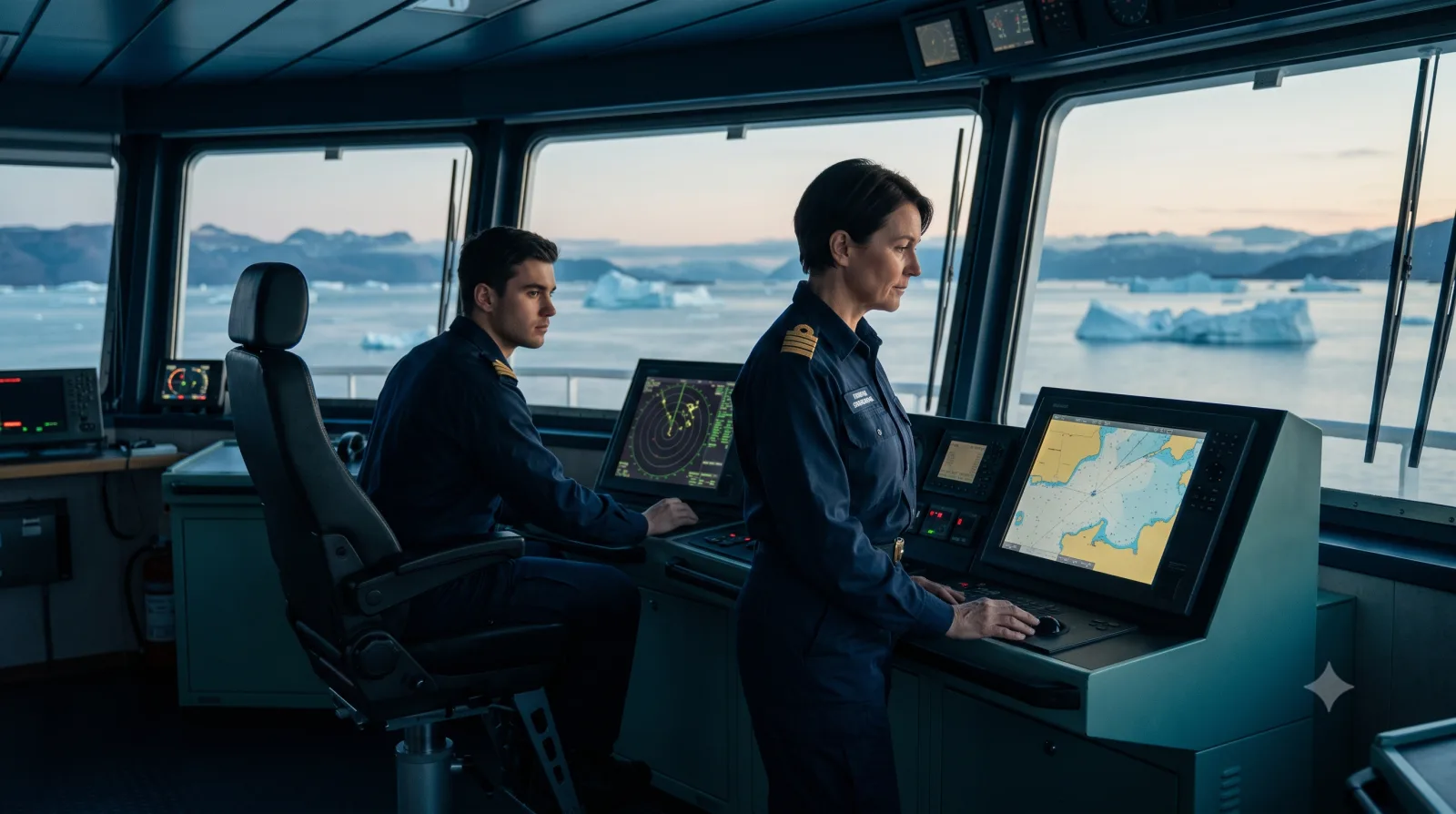
Two navigation officers on the bridge of a polar-class vessel, radar and ECDIS displays lit, icebergs visible through the windows
Every rank, one platform

From the officer of the watch to the DPA ashore — the same intelligence, scoped to what their rank needs to see.

The platform

Multi layered intelligence.

Safyrmind combines a maritime domain ontology, evidence-grounded retrieval, domain-adapted generation, human validation, and fleet-level learning into a single intelligence architecture. The layers work independently where required, but together create a closed loop in which findings are contextualised, relevant evidence is retrieved, corrective actions are generated and validated, and the resulting knowledge strengthens future predictions across the fleet.

Layer 1 · The agent

Event-driven agentic decisioning

The right audit fires to the right rank at the right moment — driven by age, event, prediction, campaign, and systemic signals.

5Trigger classes
always running
<2 mTriage to
dispatch latency
AutoSystemic-signal
escalation
Agent activity · 24 hours · fleet-wide
14 FIRED · 12 CLOSED
3:12·T-401 age
6:47·T-408 OT
11:20 · T-411 pred
0006121824
Age
Event
Predictive
Campaign
Scheduled
Systemic signal detected at 11:20 · same finding on 5 vessels in 60 d → programme-level review escalated to DPA queue.
Layer 2 · The surfaces

Multi-surface front-end

Native tablet, mobile, web, mixed-reality — each engineered for its operating context. Offline-first, wet-hand tolerant, one-hand safe.

4Surfaces
native each
30 dOffline
runtime
1-handMobile thumb
zone safe
Audit volume by surface · last 30 days
2,847 SESSIONS
📱
Tablet
42%
📲
Mobile
31%
💻
Web
21%
🥽
MR
6%
Onboard delivery mode split
Online · VSAT 58%
Low-bw 27%
Offline 15%
Every capture works offline · queued sync drains in priority order when link returns.
Layer 3 · The learning loop

Continuous training & learning

Every finding becomes a 3-minute rank-specific micro-module. Every intervention measured 90 days out — dollars saved per dollar spent.

24 hFinding → module
fleet-wide
6.1×Aggregate
ROI · L4
12Working
languages
IG O2 finding rate · L4 module deployed M0
▼ 74%
Month 0 · pre-intervention
4.2
findings / vessel-quarter
Month 3 · post-intervention
1.1
findings / vessel-quarter
Top 5 modules by measured ROI
IG O2 cal
9.0×
Enclosed space
8.3×
MLC rest hrs
6.7×
PMS Ch.6
5.3×
ECDIS familiarity
2.4×
Layer 4 · The dashboard

360° dashboard with cause-effect

A working surface, not a compliance report. The SafyrScore™ composite decomposes to five dimensions and nine regime lenses. Every panel resolves to an action.

5Risk
dimensions
9Regime
lenses
PinAny panel
per persona
Fleet dashboard · shore user landing
LIVE
Fleet score
57.7
Moderate · ▲ 3.2 · 90 d
Lowest safety · top N
5
Titan · Meridian · Sceptre
Findings open
63
39 within SLA · 24 breached
Triggers 24 h
14
12 auto-closed · 2 to review
Dimension breakdown · fleet composite
P
68
D
82
K
71
B
76
C
63
Layer 5 · The copilot

In-audit knowledge referencing

A maritime peer at hand — clause interpretation, consequence differentiation by port MoU, sourced to the original text. Voice-first onboard.

<2 sResponse
latency (p95)
100%Answers cited
to source
"safyr"Voice wake
phrase
Copilot · vetting coordinator asks Ch.6 · Q14
GROUNDED · 3 SOURCES
What does SIRE 2.0 Ch.6 Q14 actually mean, and what evidence would satisfy it?
Intent: the inspector is checking that the IG O2 analyser is capable of producing a compliant reading — calibrated within the interval required by SOLAS Ch.II-2 Reg.4.5.10 and the manufacturer.

What good looks like: cal record ≤ 90 d, live reading matching cal standard within tolerance, in-date cal-gas cert, and consistent OT stream over last 60 min.
📘 SOLAS Ch.II-2 · 4.5.10 📘 SIRE 2.0 · Ch.6 · Q14 🗂 Fleet history · 12 mo
What happens if we fail this at Yosu?
Regime-specific consequences · Tokyo MoU + active fire-safety CIC · detention risk quantified · prior history cited.
Layer 6 · The vision

Multi-modal inference

Reads gauges, documents, and photos. Transcription is the error; safyrmind removes it. Every capture cross-checked and confidence-banded.

4Modalities
read natively
≥ 90%Confidence bar
for sufficiency
CrossCal-gas + OT
stream verify
L7 inference · IG O2 analyser · Manifold deck
SUFFICIENT
O₂ %
20.7
Inferred reading
20.7% ± 0.03
Confidence94%
✓ Cal-gas cert on file
✓ OT stream steady 20.6-20.8
✓ Reading within tolerance
Layer 7 · The output

Automated reporting cadence

Weekly digests, monthly reviews, quarterly board packs, closure reports — auto-drafted, ready to defend.
4Formats
every report
RFC3161
timestamps
SHAManifest per
evidence pack
Report cadence · fleet · rolling 12 months
100% ON TIME
Weekly digest
52 / yr
Monthly review
12 / yr
Quarterly board
4 / yr
Closure reports
on demand
Evidence packs
per event
Every artifact PDF · DOCX · XLSX · ZIP · with SHA manifest + RFC 3161 timestamp.
Container ship underway at sea with seagulls flying alongside
Fleet-wide, not fleet-by-fleet

Nine regulatory regimes, one evidence trail — mapped automatically to every vessel in the fleet.

Coverage

Nine regulatory regimes.
One clause-level knowledge base.

Every audit question in Safyrmind MARIQ™, every evidence requirement, and every finding is tagged to one or more of nine regimes. The same underlying evidence propagates across every regime where it is admissible — captured once, mapped to every applicable requirement.

9 maritime assurance and compliance frameworks
One Knowledge Base
SIRE 2.0

OCIMF tanker vetting

13 chapters, three question tiers. Pre-inspection preparation, mock inspections, chapter-level readiness scoring.

RISQ 3.2

RightShip

Risk screening for bulk carriers, general cargo, container, and ro-ro ships. Continuous readiness, never point-in-time.

PSC + CIC

Port State Control

Paris, Tokyo, IO, Caribbean, Med, Black Sea, Abuja, Viña del Mar, Riyadh MoUs + USCG. CIC campaign preparation built-in.

Class

Class societies

DNV, LR, ABS, BV, ClassNK, KR, CCS, RINA, IRS. Annual, intermediate, special surveys — plus enhanced survey programme.

Flag

Flag state

Marshall Islands, Panama, Liberia, Singapore, Malta, Bahamas, HK, UK, Cyprus, Greece — each flag's emphasis modelled.

P&I

Loss-prevention surveys

IG club condition surveys, entry surveys, thematic loss-prevention. Findings routed through CAPA Forge™.

ISO Integrated

Environmental & H&S

ISO 9001, 14001, 45001, 50001 as one integrated management system. Single audit event, multi-standard evidence.

ISM

Internal audits

Rolling 12-month programme per IMO Res. A.741(18). Auditor-independence verified. DPA sign-off queue.

Internal · 5

Company-specific

Marine, Technical, Safety, Navigation, Annual VDR — five programmes, own rhythm, own ownership, own question banks.

SIRE 2.0

OCIMF tanker vetting

13 chapters, three question tiers. Pre-inspection preparation, mock inspections, chapter-level readiness scoring.

RISQ 3.2

RightShip

Risk screening for bulk carriers, general cargo, container, and ro-ro ships. Continuous readiness, never point-in-time.

PSC + CIC

Port State Control

Paris, Tokyo, IO, Caribbean, Med, Black Sea, Abuja, Viña del Mar, Riyadh MoUs + USCG. CIC campaign preparation built-in.

Class

Class societies

DNV, LR, ABS, BV, ClassNK, KR, CCS, RINA, IRS. Annual, intermediate, special surveys — plus enhanced survey programme.

Flag

Flag state

Marshall Islands, Panama, Liberia, Singapore, Malta, Bahamas, HK, UK, Cyprus, Greece — each flag's emphasis modelled.

P&I

Loss-prevention surveys

IG club condition surveys, entry surveys, thematic loss-prevention. Findings routed through CAPA Forge™.

ISO Integrated

Environmental & H&S

ISO 9001, 14001, 45001, 50001 as one integrated management system. Single audit event, multi-standard evidence.

ISM

Internal audits

Rolling 12-month programme per IMO Res. A.741(18). Auditor-independence verified. DPA sign-off queue.

Internal · 5

Company-specific

Marine, Technical, Safety, Navigation, Annual VDR — five programmes, own rhythm, own ownership, own question banks.

Cross-regime map · A rest-hour log satisfies MLC in the Flag audit, crew management in RISQ 3.2, competence in ISM Element 6, and Ch. 10 crew questions in SIRE 2.0 — all from one capture. safyrmind maintains the map so evidence propagates automatically.
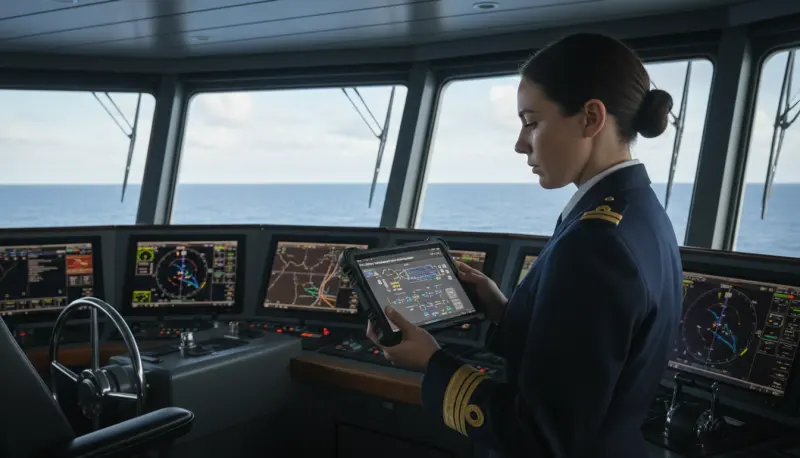
Ship captain using a tablet in the wheelhouse at sea
Continuous, not point-in-time

The audit runs whether or not the inspector is on board — and whether or not the link is.

Before & after

Twelve months on the platform.
Here is what the same fleet looks like.

A mid-size tanker operator — 28 vessels, average age 11 years, mixed trade — modelled at rollout and again 12 months later. The score, the trend, and the metrics that drive them. No editorial gloss; the numbers that changed.

Illustrative operator scenario — modelled, not a live customer result
Month 0 · Baseline

SafyrScore™ — fleet safety

Falling trend · reactive audit programme
31.5
Weak
▼ 4.8 vs prior year
12-MONTH TREND DETERIORATING
Detentions · 12 mo
3
≈ $540k direct cost
Vetting failures
7
Charter losses on 2 hulls
Finding recurrence
54%
Same category, new vessel
Median CAPA close
62 d
Against 21-day SLA
Month 12 · Post-rollout

SafyrScore™ — fleet safety

Improving trend · continuous anticipation
85.8
Strong
▲ 54.3 vs baseline
12-MONTH TREND IMPROVING
Detentions · 12 mo
0
2 predicted & averted
Vetting failures
1
86% reduction
Finding recurrence
18%
Systemic signals closed
Median CAPA close
19 d
Within SLA · 69% faster
Illustrative composite based on typical outcomes across comparable tanker operators in the first 12 months. Model the numbers for your own fleet in the ROI calculator below.
Return on investment

Model your operational-risk exposure.
See what safyrmind returns.

Every input below drives the same SafyrScore™ methodology in real time. Impact ranges are calibrated against IG Club and industry-benchmark data. The model estimates potential savings using comparable fleet benchmarks and your fleet profile.

Your fleet profile

Adjust the sliders. The result updates as you move.
25 vessels
11 years
3 per vessel
Modelled outcome · 24 months

Your expected return

Annual operational-risk exposure avoided (P50)
$1.2M
P75 $1.9M · P95 $3.2M
Detentions avoided
1.2 / yr
≈ $180k cost avoided
Vetting pass rate lift
+18%
≈ $840k charter revenue protected
CAPA closure time
-42%
Median days-to-close
Aggregate ROI
6.1×
Loss reduction per platform dollar
Illustrative, model-based estimate — not a guarantee of results. Calibrated on comparable fleet outcomes at the 24-month mark, with impact ranges anchored to IG Club claims data and MoU detention cost benchmarks. Actual results vary by fleet, trade lane, and execution — book a demo to see the model tuned to your specific vessel mix and trade lanes.
Ship officer reviewing digital compliance documents on a tablet on the bridge
ON THE BRIDGE — WHERE THE AUDIT ACTUALLY HAPPENS
About safyrmind

Built by seafarers.
Engineered by AI experts.

Founded by Master Mariners and software engineers who bring together two kinds of expertise rarely found in the same team: deep maritime operating experience and deep technical expertise in AI, LLMs, and enterprise software.

The wider team combines Master Mariners, ex-vetting inspectors, DPAs, technical superintendents, AI researchers, and enterprise engineers. That combination gives safyrmind both the domain depth to understand the problem and the engineering depth to solve it at the system level.

Our engineering founders have built software and technology at some of the world's leading technology companies, with deep expertise in AI and production-grade software systems. Our maritime founders have commanded ships, conducted audits, defended findings, and lived the operational consequences the platform is designed to anticipate.

We are building a maritime-first AI platform — not a general-purpose LLM with a shipping wrapper. Maritime knowledge, finding patterns, regulatory context, operational workflows, and rank-specific decisioning are embedded throughout the system.

We don't just apply AI to maritime.
We combine maritime expertise with the engineering depth to build AI that understands how the industry actually works.

Domain-native

Built from real audits, real findings, real operational decisions, and decades of maritime experience. The domain is the source of truth, not simply a target market.

AI-native

Deep AI engineering spanning model development, adaptation, and production deployment — built for one domain, not retrofitted from a general-purpose model.

Evidence-grounded

Recommendations are grounded in clauses, records, evidence, and modelled probabilities with explicit confidence — not unsupported AI opinions.

Command-respecting

AI assists; accountable officers decide. Sign-off authority remains with the person responsible for the operation.

Trust & security

Built for regulated
enterprise scale.

Encryption

AES-256 at rest, TLS 1.3 in transit.

Data residency

EU · US · APAC regions — you choose primary and DR.

Full audit trail

Actor, timestamp, before / after — every mutation.

Model lineage

Every output traces to inputs, corpus, and version.

An officer reviewing fleet data on a tablet at a container terminal gangway, a dockworker visible behind
Evidence you can stand behind

Every score, every flagged finding, traces back to the audit that produced it — on deck, in port, wherever the work happens.

Ready to see
your fleet's audit intelligence?

Book a 30-minute demo. We will show the platform running on a comparable fleet to yours — with the risk model, the copilot, and the CFO view tuned to your operational reality.

Talk to the team